

My phone died at the worst possible moment on a shore excursion last year. I was standing in a cobblestone square, trying to remember which street led back to the ship, and the screen just went black. No map, no photo of the ticket, no way to call my sister June, who was two streets ahead of me. I found my way back eventually, but I decided right then that I would never travel again without a power bank. I bought the INIU a few days after we got home, and this is the routine I have used on every trip since. It has not failed me once.
The Power Bank That Fixed This Problem for Me
The INIU 10000mAh portable charger is small enough for a jacket pocket, light enough for a shoulder bag, and it has kept my phone going from breakfast to bedtime on every trip I have taken with it. It is the one piece of gear I now pack before my socks.
Amazon Check Today's Price on Amazon →Step 1: Charge the Power Bank the Night Before
The night before a full day of sightseeing, I plug the INIU into the wall and leave it until the little indicator lights show it is full. It takes a few hours, so I do it while I am having dinner or reading before bed. I learned the timing the hard way on my first trip with it. I plugged the bank in right before I turned out the light, and it was still not full when I woke up. Now I start it earlier, right after June and I come back from dinner, and I give it the whole evening. I check the indicator lights again before I unplug it in the morning. It takes two seconds, and it saves me from carrying a half-charged bank around a city all day.
I keep the cable that came with the INIU right beside it in my bag, coiled around the bank itself. If the cable is attached to the charger, I cannot forget it. I learned this the hard way on an earlier trip when I packed the charger and left the cable in the hotel bathroom. Now they live together, always.
If you are charging the bank in a hotel room, put it somewhere you will see it in the morning, like beside the coffee maker or on the desk by the door. A power bank that is still plugged in when you leave the room does you no good at all. I once left mine on a windowsill behind the curtain and had to go back for it, which is exactly the kind of delay that makes a tour group grumble.
Step 2: Top Off Before You Leave the Hotel
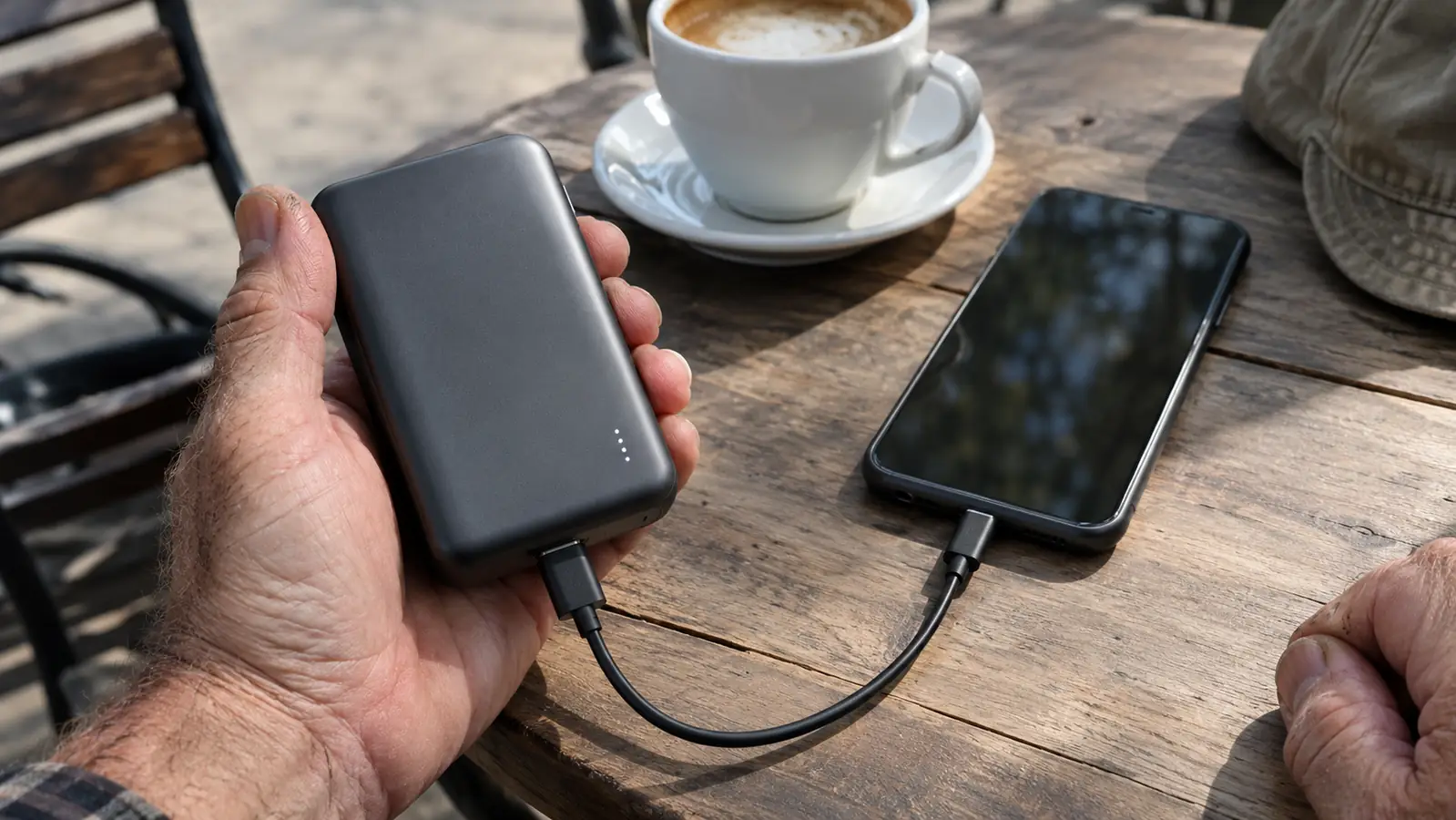
In the morning, while I am waiting for June to find her sunglasses or her room key, I plug my phone into the INIU for ten or fifteen minutes. This is not about a full charge. It is about starting the day at 100 percent instead of 84 percent. That extra cushion is what gets me through the long afternoons when I am using the map app and taking photos at the same time. On a walking tour last fall, that morning top-off was the difference between having a working phone at dinner and borrowing June's.
I also turn off the things I am not using before I walk out the door. Wi-Fi, Bluetooth, and background app refresh all quietly drain a phone. On an all-day outing, that quiet drain can add up to fifteen or twenty percent by dinner. I do not go so far as airplane mode, because I like being reachable, but I do close the apps I will not need. This takes thirty seconds and it is the cheapest battery saver there is.
One more thing: I put the INIU in the outside pocket of my Travelon messenger bag, not buried at the bottom. If my phone starts to drop, I can reach the charger without stopping the whole group. That matters when you are walking with a tour group that does not wait.
Step 3: Charge in Small Bursts During the Day
The habit that changed everything for me is charging in small bursts instead of waiting for the phone to get low. When we stop for coffee, I plug in. When we sit on a bench to look at a view, I plug in. When we are waiting for a table at lunch, I plug in. Ten minutes here and fifteen minutes there keeps the phone above 60 percent all day, and the INIU is small enough that this never feels like a hassle. On a museum day in Denver last spring, I took photos of every exhibit that caught my eye, looked up the tram schedule three times, and texted my daughter about where to meet for lunch. By two o'clock my phone was down to 40 percent. We sat in the museum cafe, I plugged into the INIU, and by the time we finished our coffee the phone was back above 80. That one burst carried me through the rest of the afternoon, and the INIU still had plenty of charge left when we finally sat down for dinner.
A 10000mAh bank like this one holds roughly two full charges for a modern phone, sometimes a little more depending on the phone. That sounds like a lot, but map use, photos, and the occasional video call eat through battery faster than people expect. The small-burst habit means I rarely use more than half of the bank's capacity in a full day, which leaves a comfortable reserve for the evening. I have come back to the hotel with the bank still better than half full more times than I can count, and that reserve is what lets me relax at dinner instead of watching the percentage.
I keep the cable short and neat. A long cable tangles in a bag and takes forever to stuff back in. The cable that comes with the INIU is the right length for this, long enough to reach from my bag to my hand, short enough to stay out of the way. When I am done, I wrap it around the bank and tuck both into the pocket. It takes less than a minute.
The small-burst habit means I rarely use more than half of the bank's capacity in a full day, which leaves a comfortable reserve for the evening.

Step 4: Make the Power Bank Work While You Walk
The INIU is light enough that I can carry my phone in one hand and the charger in the other while walking, with the cable running between them. I do this on long stretches when I am following a map or waiting for June to catch up. The phone charges as I walk, and by the time we reach the next stop, it is back up to a comfortable level. The bank is small enough to sit in my palm without making my hand ache, which matters to me because my hands are not what they used to be. I switch hands every few blocks, and the phone goes in my pocket when I need both hands for a railing or a curb.
This is also the moment when a power bank with a decent cable matters. The INIU charges at up to 45 watts, which sounds technical, but what it means in practice is that the phone charges quickly instead of creeping up a percent at a time. A quick charge while you walk beats a slow charge while you sit, because the phone is doing something useful the whole time. On a slow charger, twenty minutes plugged in barely moves the needle. With the INIU, twenty minutes of walking usually adds thirty or forty percent, which is the difference between skipping the last stop and enjoying it.
If you are carrying the bank in a bag while you walk, tuck the cable through a loop or a zipper pull so it does not dangle. I clipped mine to the strap of my Travelon messenger bag with a small carabiner, and now the phone can sit in my hand while the bank stays in the bag. One afternoon in Denver, my daughter mapped out a walking route along the riverfront, and I kept my phone in my hand for nearly two hours, checking the route and taking pictures. The INIU rode in my bag the whole time, the cable clipped to the strap, and the phone gained charge as we walked. When we stopped for ice cream, I unplugged, coiled the cable, and went back to taking photos without ever looking for a wall outlet.
Step 5: Recharge the Bank in the Evening
When we get back to the hotel or the ship in the evening, I plug the INIU into the wall first, before I do anything else. It takes a few hours to fill back up, so if I wait until bedtime it might not be ready for the next morning. Charging it while I wash up and change for dinner means it is full by the time I turn out the light. On the cruise, I learned to claim the outlet near the desk early, because by evening every outlet in the cabin was spoken for.
I also plug my phone in at the same time, so both devices are ready for the next day. This evening routine takes two minutes and it means I never start a day tired, sore, and low on battery.
Once a week or so, I let the INIU run all the way down before I recharge it. This is not strictly necessary with modern batteries, but it is a good way to check that the bank still holds the charge it should, and it gives me peace of mind before a long trip.
What Else Helps
A power bank is the center of the system, but it is not the whole system. I also travel with a short wall charger that has two USB ports, so I can charge the phone and the bank at the same time in the hotel room. On the river cruise June and I took, our cabin had exactly one outlet near the bed. With the two-port charger, we could charge both phones and the INIU overnight without taking turns. That one little detail saved us every single night. I keep my phone in a case that does not fight the charging cable, and I check my cable connections before I leave, because a loose cable is the most common reason a charge fails. I also carry a spare cable in the front pocket of my carry-on, rolled small, so if one cable gives out mid-trip I am not hunting for a shop that sells phone chargers in a language I do not speak.
I also learned to be honest about how much battery I actually need. The phone's battery settings page shows exactly which apps are doing the most damage, and checking it once in a while taught me which habits to break. I stopped leaving the map open in the background, and that alone added hours to my battery life. On that same cruise, some days we were on shore for six or seven hours and other days we never left the boat. I brought the INIU on the long days and left it in the cabin on the short ones. If I am going to be out for six hours with no lunch stop, I bring the INIU and I keep my phone in my bag instead of in my hand. If I am going to be out for two hours, I often leave the bank in the hotel room and just top off before I leave. The bank is for the long days, and knowing the difference keeps me from carrying extra weight I do not need.
For anyone who travels with a companion, I will add this: tell them where the power bank is. June and I have a standing rule that the INIU lives in the outside pocket of my bag, and if her phone dies, she knows exactly where to find it. It sounds small, but it has saved us more than once when one of us needed to look up a train time or a restaurant address.
Start Tomorrow With a Full Charge, Not a Dead Phone
The INIU 10000mAh portable charger is the piece of gear I now pack before my socks. It is small, light, and it has kept my phone going from breakfast to bedtime on every trip I have taken with it. If you are tired of watching your phone die at the worst possible moment, this is the fix.
Amazon Check Today's Price on Amazon →