
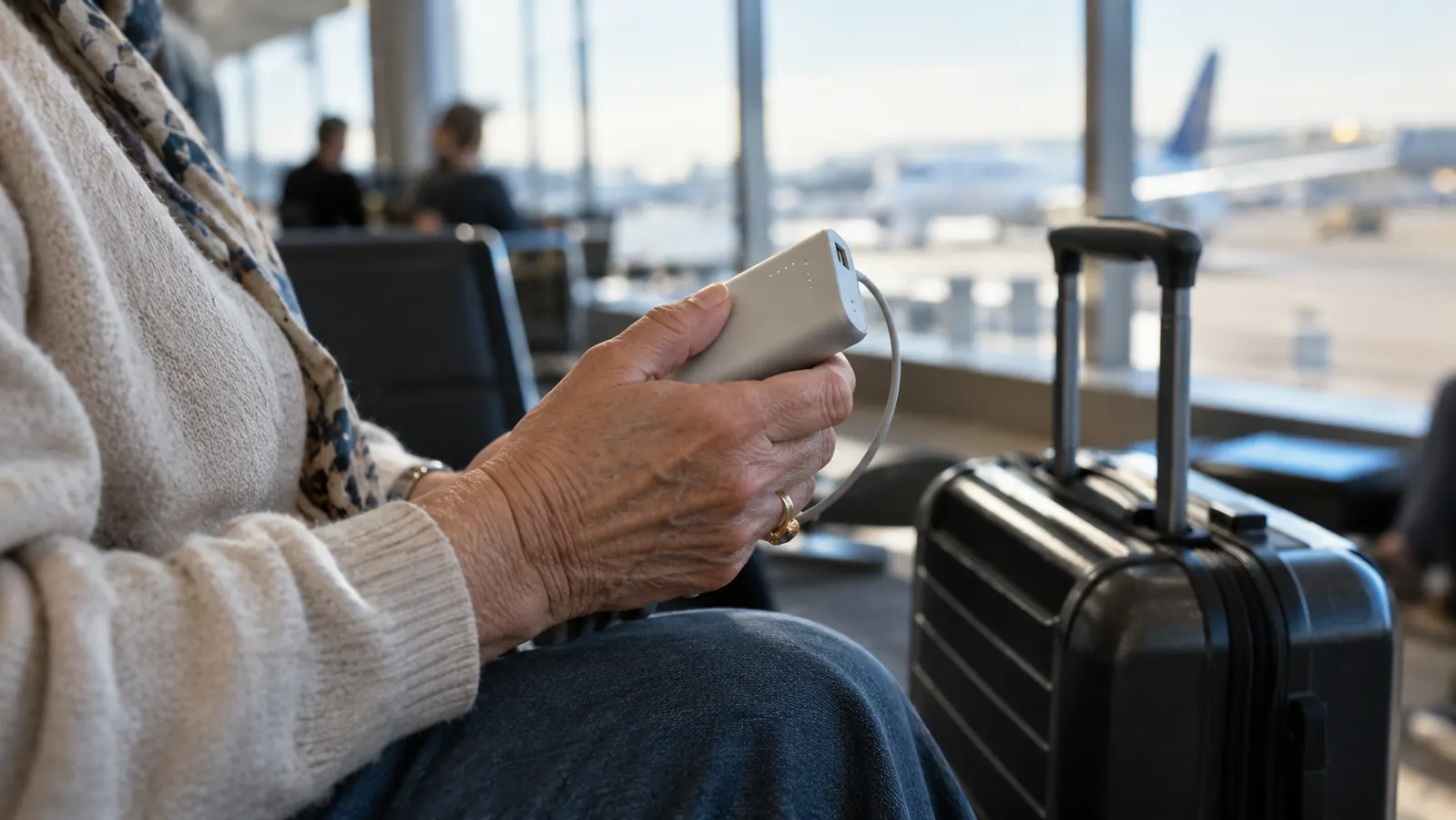
I will tell you the part nobody puts in the product photos. The INIU 10000mAh portable charger is not exciting. It is a small, flat rectangle that sits in my travel bag and does its job without a single complaint. After a year of using it on flights to Denver, two cruises with my sister June, and one very long day in a city where my phone died at 2 percent, I think that is exactly the point.
I am Loretta Haines. I am 79, I have stiff knees and mild arthritis in my hands, and I travel three or four times a year with one carry-on and one personal item. I bought the INIU about a year ago after my phone died during a shore excursion. Before that I carried no charger at all and relied on wall outlets. This review is the honest version of what that year was like.
The Quick Verdict
The INIU 10000mAh is the rare travel gadget that earns its spot in my bag every single trip. It is light, easy to read, and simple enough for tired hands. It is not the fastest charger I have ever used, and the cable is short, but I have never once regretted carrying it.
Amazon Check Today's Price →The portable charger I now pack before I pack my socks
If you are tired of hunting for wall outlets in airports and cruise ship cabins, this is the small, dependable charger that fixed that problem for me. It sits in my personal item for every trip now.
Amazon Check Today's Price on Amazon →How I Have Used It
I have used the INIU on six flights to Denver, two cruises, three train rides, and more airport layovers than I can count. It has charged my phone in a window seat, in a cruise ship cabin, on a bus tour, and once on a park bench while I watched a man try to find an outlet near a food court. He did not find one. I did not need one. The first cruise was a week on the Danube with June, and the second was ten days in the Mediterranean. In both cabins the only outlets were behind the television, which meant charging my phone meant standing in the corner with the TV pulled out. The INIU ended that nonsense on the second day of the first cruise.
My phone is a few years old and the battery does not hold charge the way it used to. On travel days it drops fast, especially with the camera going and the maps open. The INIU has taken it from single digits to full more times than I can count. I charge the INIU itself the night before a trip, and it holds that charge for days. That reliability is the whole reason I keep reaching for it. Last March I flew out of Greenville at 6:40 in the morning. I had charged the INIU the night before, and by the time we landed in Denver, my phone had gone from full to 40 percent twice, and the INIU had brought it back to full both times without dropping below half of its own charge. That is the kind of day this charger was made for. My daughter picked me up at the airport and asked if my phone had lasted the whole flight. I told her it had, thanks to the little rectangle in my bag.
The train rides were mostly short hops in Europe, and the INIU came in handy on every one. Train carriages in Europe do not always have outlets near the seats, and the ones that do are often taken. I stopped worrying about it once I had the INIU. I would plug in during the first few minutes of the ride and have a full phone by the time we pulled into the next station.
The screen shows the remaining charge as a number. That sounds like a small thing, but at my age, a number beats a row of tiny blinking lights. I can glance at it and know whether I need to top it up before I leave the hotel. I do not have to squint or hold it at an angle. In the dim light of a cruise ship cabin, I can read it without my reading glasses. That matters more than you would think, and it is the detail I mention first when someone asks me whether the INIU is worth carrying.
What Nobody Tells You About the INIU
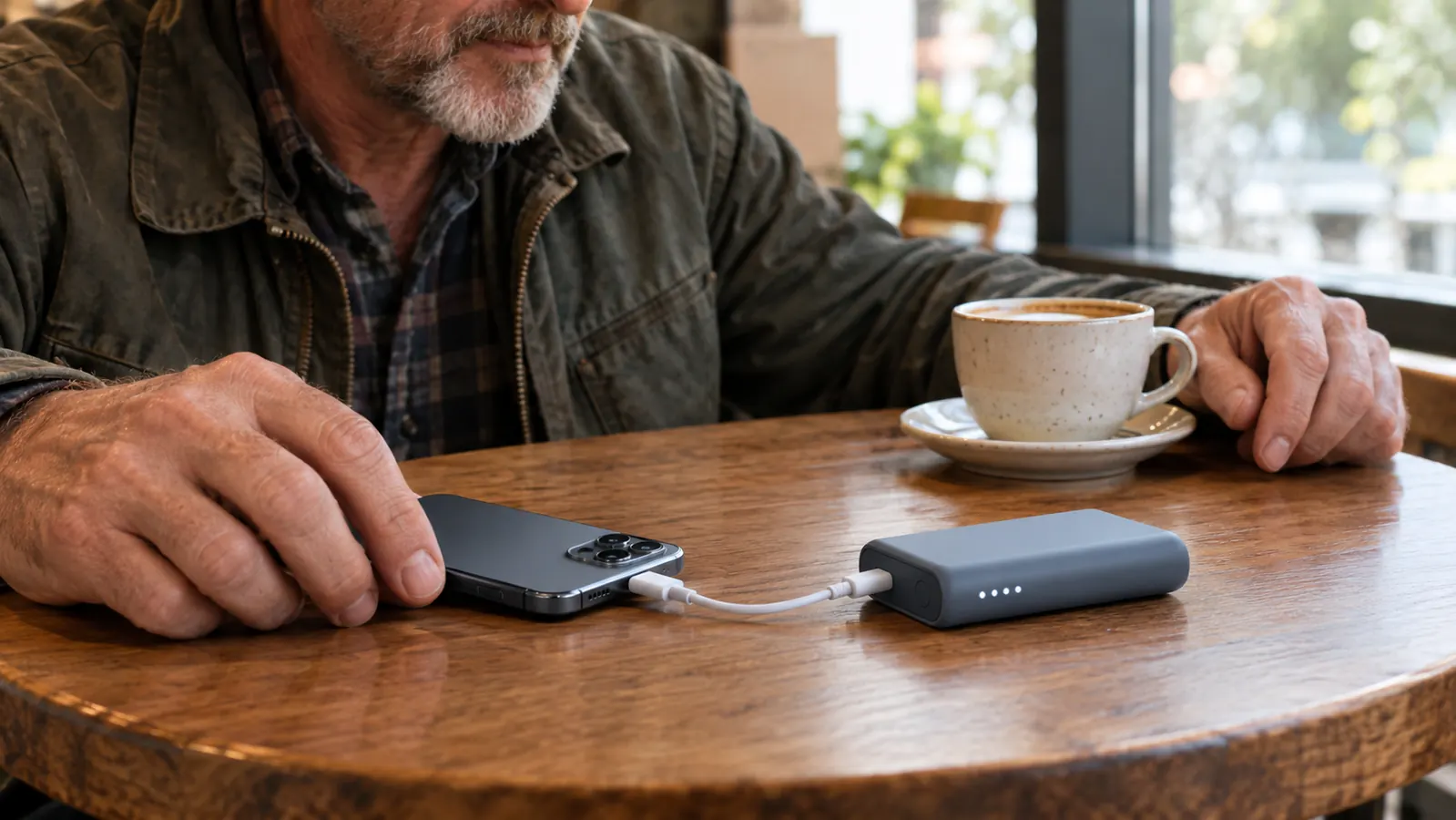
Here is what the glossy product pages leave out. The INIU is not the smallest charger you can buy, and it is not the fastest. What it is, is the most sensible. The 10000mAh capacity is the sweet spot for a traveler who does not want to check a bag. It is small enough to slip into a personal item without adding noticeable weight, and big enough to charge a phone several times over a long day. It is about the size of a deck of cards and weighs about as much as a small paperback. I know because I have held it in one hand and a book in the other. It adds nothing to my bag that I notice, and I notice every ounce when I am lifting my carry-on into the overhead bin.
The 45W output sounds technical, but here is what it means in real life. When I plug in my phone, it charges at a steady, sensible pace. It is not the frantic fast charge you get from a wall adapter, and it is not the trickle you get from a laptop USB port. It is somewhere in between. I have learned to plug in early on a long flight and let it do its work while I read. On the flight to Denver last March, my phone went from 15 percent to full in about an hour and a half. I timed it once out of curiosity, because I am the kind of person who times things. The pace suited me fine.
The built-in cable is short. That is the honest con. If my phone is in my pocket, the charger has to sit in my pocket too, or I have to hold both. On a plane I usually set the charger on the tray table and lay my phone beside it, which works fine. In a crowded seat it can feel a little awkward. I have learned to work around it, but I wish the cable were six inches longer. The cable is built in, which means I cannot lose it, and that tradeoff is one I have made peace with. I have lost more phone cables over the years than I care to count.
The other thing nobody tells you is that the charger gets warm. Not hot, not alarming, just warm, the way any device does when it is working. The first time I felt it I checked the instructions, and everything I read said it was normal. I mention it because I would rather you know now than worry at 30,000 feet. On a flight last fall I left it charging my phone for two hours straight. When I picked it up, it was warm to the touch but not uncomfortable, and the screen still showed 40 percent of its own charge left. That is when I stopped checking on it.
The button is on the side and easy to find by feel, which matters when I am digging for it in a dark cabin. It takes one press to start charging and one press to stop. There is no app, no pairing, no blinking pattern to learn. For hands with arthritis, that simplicity is the whole point. I do not have to pinch anything or hold anything at an awkward angle.
The INIU is not exciting. It is dependable, which at my age is the better thing to be.
The Day My Phone Died in a Foreign City
The moment that convinced me happened on a cruise stop. June and I had wandered farther from the ship than we planned, following a market street that kept going. It was a port city on the Adriatic, and the old town was full of stalls selling lace, olive oil, and leather goods. We stopped for coffee, then kept walking. My phone had been taking pictures all morning, and the maps app had been running since we left the ship. When I looked down, it said 2 percent. The walk back was a mile of cobblestones, over a bridge and up a hill. It was not quite noon, and the ship was due to leave at five, so I had time, but I did not want to spend it lost. I did not panic, because I knew the INIU was in my crossbody bag. I had charged it the night before, and I knew it was full.
I found a bench in the shade, plugged in, and waited. Ten minutes later I had enough charge to pull up the map and find the right direction. Twenty minutes later I had enough to call June and tell her where I was. That is the whole argument for carrying one of these. It is not about charging your phone to full. It is about never being stuck. I sat on that bench, watched the market go about its morning, and felt the kind of calm that comes from knowing you have what you need. The bench was in front of a pastry shop, and I will not pretend that was an accident. I ordered a small tea while I waited, and the shopkeeper did not seem to mind that I stayed for twenty minutes. He asked where I was from, and we talked about his granddaughter in Toronto.
Before I bought the INIU, I would have been the woman asking a café owner if I could sit near an outlet. Now I am the woman who sits down, plugs in, and orders a cup of tea at my leisure. That independence is worth more to me than any spec sheet. I told June about it later that evening, and she said she was getting one for herself before the next trip. She has not yet, but I keep reminding her. The charger stays in my bag, and the peace of mind stays with me.
How It Handles Real Travel Conditions
I have dropped the INIU onto a tile floor in a train station. I remember the exact moment. It was in Salzburg, and I was juggling my crossbody bag, a bottle of water, and a paper bag of pastries. The charger slipped out of my hand and hit the tile with a crack that made a man two benches over look up. I picked it up, checked the screen, and it was still showing 62 percent. It has worked perfectly ever since. I have also packed it in the bottom of a tote under a paperback and a bag of cough drops, and left it in a hot car for an afternoon by accident. Last summer I left it in the car while June and I had a long lunch, and the afternoon sun had made the car hot enough that the steering wheel was too warm to hold. When I came back, the charger was warm but fine, and it charged my phone normally that evening. The casing is smooth and plain, and the corners are rounded enough that it does not dig into anything. Nothing about it has ever caught on a zipper or snagged a sweater.
The screen is my favorite part. It shows the charge level as a number, which is a small mercy for eyes that have read a lot of library books. I can check it in dim cruise ship lighting without reaching for my reading glasses. That is the kind of detail the marketing photos never mention, and it is the reason I reach for this charger instead of the one my son offered to lend me. His is bigger, heavier, and has four little lights that all look the same to me. The INIU tells me exactly what I need to know, in a number I can read from across the room.
It also plays nicely with airport security. I have carried it through scanners in the United States, Canada, and three countries in Europe, and never once had it pulled aside. I keep it in the outside pocket of my Travelon messenger bag with the cable tucked around it, and the agents have waved me through every time. For a traveler in her late seventies, not having to unpack the bag is a genuine relief. I have watched younger travelers empty their whole carry-on because of a forgotten bottle of water or an unplugged laptop. I would rather not be that woman, and the INIU has never once made me that woman.

The Pros and Cons, Plainly
What I Liked
- Small and light enough to live in a personal item without adding noticeable weight
- The charge level shows as a number, so I can read it without my glasses
- Holds its charge for days, so I can top it up the night before a trip and trust it
- Charges a phone at a steady, sensible pace, fast enough to be useful and slow enough to be safe
- Has survived drops, heat, and the bottom of my tote without a scratch
Where It Falls Short
- The built-in cable is short and can feel awkward in a cramped airplane seat
- It gets noticeably warm while charging, which surprised me the first time
- It is not the fastest charger I have used, so I plug in early on long travel days
Who This Is For
This INIU is for the traveler who wants one less thing to worry about. It is for the person who has stood in an airport terminal with a dead phone and a long layover, or the person who has watched their phone battery drain on a bus tour with no outlet in sight. If that sounds like you, this charger will earn its place in your bag.
It is also for the person who does not want to learn a new gadget. There is one button, one screen, and one cable. You plug in, you wait, you unplug. My sister June, who is not patient with technology, figured it out in under a minute. That is the highest compliment I can give any device. She used it on the second cruise to charge her phone during a long bus tour, and she did not once ask me how it worked.
Who Should Skip It
If you need to charge a laptop, this is not the charger for you. The 45W output will handle a phone and smaller devices, but a full-size laptop needs more power than this little rectangle can give. If you travel with a computer and expect to work on a long flight, look for a larger power bank with higher output. My son travels with a laptop for work and brings his own larger power bank, and he has shown me the difference in size. It is considerable.
If you want the fastest possible charge, this is also not the one. There are chargers that will fill a phone in half the time, but they are bigger, heavier, and harder to pack. For my carry-on lifestyle, the tradeoff is worth it. For someone who needs speed above all, it may not be.
And if you only ever travel with a phone that lasts all day on a single charge, you may not need a power bank at all. I did not carry one for years. But the day my phone died on that shore excursion, I decided the small weight in my bag was worth the peace of mind. That is a personal call, and I respect either answer. If you do decide to carry one, this is the one I would hand you without hesitation.
Six flights and two cruises later, I still pack the INIU first
If you are ready to stop hunting for outlets and start enjoying the trip, this is the small, dependable charger that has done that for me for a full year. It is the last thing I put in my personal item before I close the zipper.
Amazon Check Today's Price on Amazon →